JSS 0251 and JSG 0308
Explained
If you are an OEM preparing documentation for submission to the Indian Ministry of Defence, you will encounter two standards that define how your technical literature must be structured: JSS 0251 and JSG 0308. Understanding the purpose, scope, and practical application of each is essential before any documentation project begins.
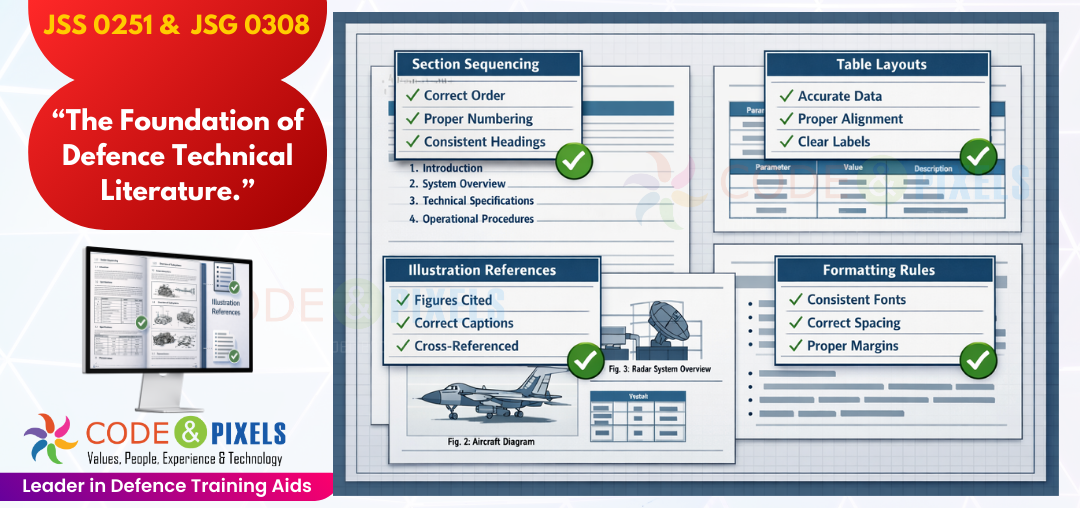
Build accurate, compliant, and professional Defence Technical Literature with JSS 0251 & JSG 0308 covering structure, tables, illustrations, and formatting essentials.
What is JSS 0251?
JSS 0251 (Joint Services Specification 0251) is the governing standard for Technical Manuals (TMs) produced for MoD procurement programmes. It defines the full structure of a technical manual, including how it should be organised by volume, chapter, and section; the language and style conventions to be followed; the way maintenance tasks are categorised by skill level; and the format requirements for tables, warnings, cautions, and notes.
A compliant JSS 0251 document is one where a reader—whether a technician, inspector, or reviewing officer—can navigate the content intuitively, because every section appears where it is expected to appear. Any deviation from this predictable structure raises a flag during review.
What is JSG 0308?
JSG 0308 (Joint Services Guide 0308) covers the preparation of User Handbooks (UHB) and Illustrated Spare Parts Lists (ISPL). These are documents used by end users and field maintenance teams, and they have distinct formatting requirements from the higher-level TMs covered under JSS 0251.
For UHBs, JSG 0308 specifies how operating procedures should be presented step by step, including the visual presentation of warnings and safety notices. For ISPLs, it governs the layout of parts identification tables, the integration of exploded view engineering drawings, and the cross-referencing conventions that allow technicians to identify and order replacement components efficiently.
Why Correct Application Matters
Both JSS 0251 and JSG 0308 are detailed, multi-section documents. The challenge for OEMs is not reading the standards—it is interpreting and applying them correctly across a complex, multi-volume documentation package that may include dozens of chapters, hundreds of figures, and thousands of individual technical data points.
Common Compliance Failures
Failures often include incorrect pagination and chapter numbering, figure captions that don’t follow the prescribed referencing format, parts tables where column widths or data sequence deviate from the standard, and missing annexures that are mandatory under specific procurement conditions.
Defence Ready Documentation with JSS 0251 & JSG 0308 Standards
Ensure compliant, accurate, and mission-focused technical publications that support operational excellence and maintenance efficiency.
Practical Steps Toward Compliance
OEMs and their documentation teams should consider the following when preparing JSS 0251 and JSG 0308 compliant documentation:
-
Document Mapping
Begin with a document plan that maps each deliverable to its applicable standard section.
-
Style Templates
Use pre-built style templates that enforce heading levels, table formats, and paragraph styles automatically.
-
Structural Reviews
Conduct a structural review before content population, not after.
-
Reference Checks
Cross-check all figure and table references against the final compiled document.
-
Final Validation
Validate the complete package against JSS 0251 and JSG 0308 checklists prior to submission.
Building Expertise Through Practice
Compliance with these standards is a capability that is built through project experience, not training courses alone. Organisations that regularly produce defence documentation develop intuitive familiarity with reviewer expectations—and this familiarity directly reduces the number of revisions cycles a document package goes through before final acceptance.
For OEMs that lack this in-house expertise, partnering with a specialist documentation provider experienced in JSS 0251 and JSG 0308 is the most reliable path to submission-ready technical literature.